

Blog
Balance Board Exercises: 12 Effective Moves to Improve Stability and Core Strength

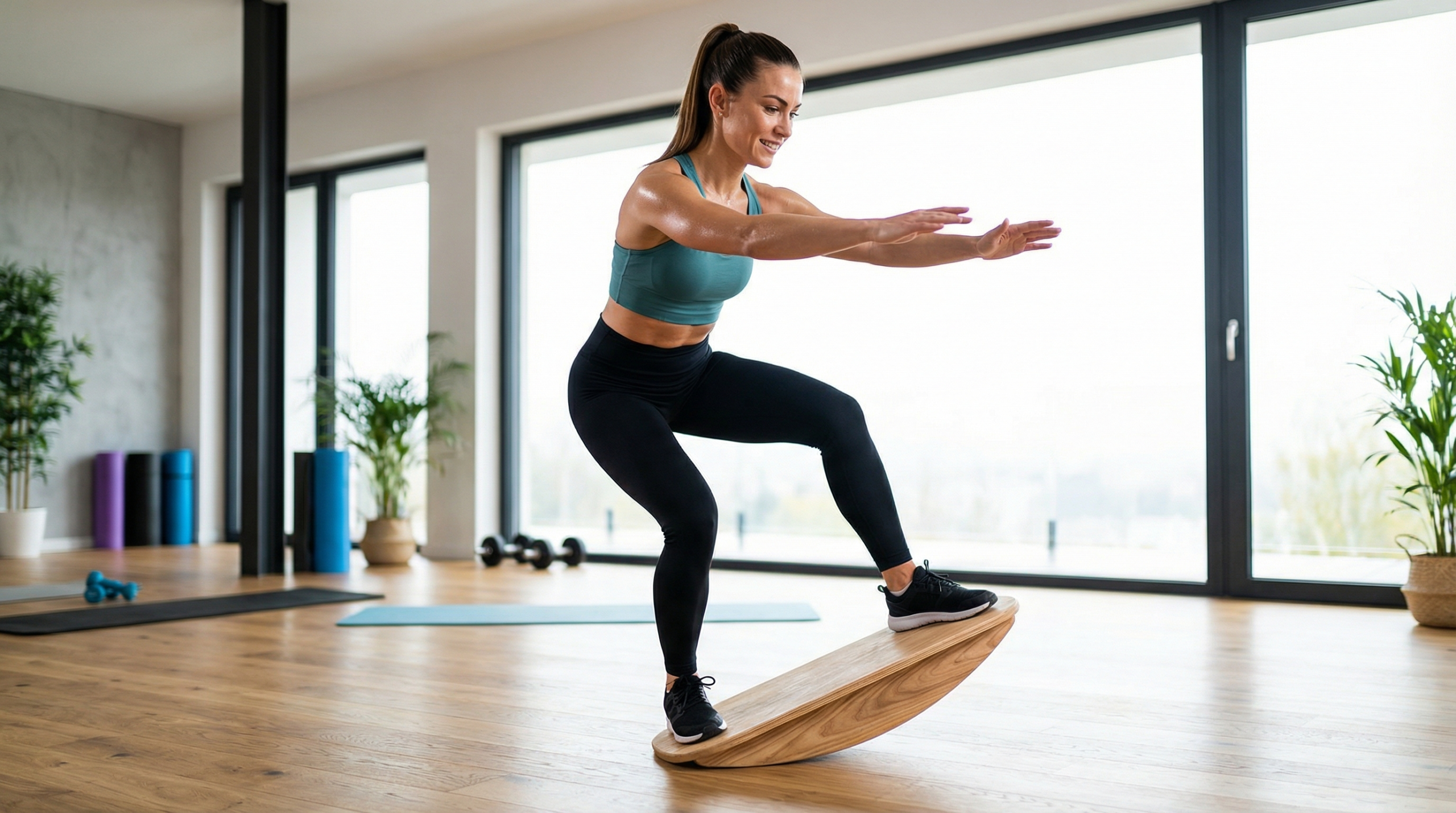
A balance board creates an unstable surface that forces your body to constantly adjust and stabilise, engaging muscles throughout your core, ankles, and legs that rarely activate during standard exercises. This simple piece of equipment delivers genuine results for injury prevention, rehabilitation, sports performance, and everyday functional fitness.
Whether you’re recovering from an ankle sprain, training for surfing or skiing, preventing falls as you age, or simply building a stronger core, balance board exercises provide versatile training suitable for all fitness levels. The wobble board benefits extend far beyond basic balance improvement—regular practice enhances proprioception, strengthens stabiliser muscles, and builds the neuromuscular control essential for confident movement.
This guide covers 12 effective balance board exercises organised by difficulty level, explains the science behind wobble board training, and provides sample workout routines you can start today.
The Science Behind Balance Board Training
Balance training works by challenging your vestibular system and improving proprioception—your body’s awareness of its position in space. When standing on an unstable surface, your nervous system processes constant feedback from your muscles, joints, and inner ear, learning to make rapid micro-adjustments that maintain equilibrium.
Research confirms that regular balance board training produces measurable improvements in both static balance (holding steady positions) and dynamic balance (maintaining stability during movement). These neurological adaptations transfer directly to improved coordination, faster reaction time, and reduced injury risk in daily activities and sports.
The continuous core engagement required to maintain stability builds functional strength more effectively than isolated abdominal exercises. Your stabiliser muscles activate constantly, creating genuine core stability that supports proper posture and protects your spine during all movement patterns.
Balance Board Benefits
Understanding the complete range of wobble board benefits helps maintain motivation throughout your training journey.
Core Strengthening and Postural Improvement
Every balance board exercise engages your entire core—abdominals, obliques, and lower back muscles—to maintain stability. This constant muscle activation builds functional core strength that improves posture and reduces back pain associated with poor spinal alignment. Unlike crunches or planks that work muscles in isolation, balance training creates integrated core stability that transfers to real-world movement.
Ankle Stability and Injury Prevention
Balance training strengthens the small muscles and ligaments surrounding your ankles, dramatically reducing sprain risk. Many physiotherapists prescribe wobble board exercises specifically for ankle rehabilitation following sprains and for preventing future injuries. The enhanced proprioception helps your body react quickly to unexpected terrain changes, protecting your ankles during sports and daily activities.
Enhanced Sports Performance
Athletes in surfing, skiing, snowboarding, skateboarding, and other balance-dependent sports use balance boards to develop sport-specific stability and agility. The training translates directly to improved performance on waves, slopes, and boards by building the neuromuscular control these activities demand.
Fall Prevention for Seniors
Balance naturally deteriorates with age, increasing fall risk significantly. Regular balance board exercises help older adults maintain stability, confidence, and independence. The improved proprioception and reaction time developed through consistent practice provide essential protection against dangerous falls.
Rehabilitation Support
Balance boards feature prominently in physiotherapy programmes for ankle sprain recovery, ACL recovery, and knee rehabilitation. The controlled instability allows progressive challenge that rebuilds stability without overstressing healing tissues. Wobble board physiotherapy exercises restore confidence in movement whilst preventing re-injury.
12 Best Balance Board Exercises
These exercises progress from foundational movements through intermediate challenges to advanced training. Master each level before progressing to ensure safe, effective development.
Beginner Balance Board Exercises
These foundational movements build basic stability and confidence on the unstable surface.
1. Two-Foot Standing Balance
Muscles targeted: Core, ankles, lower legs
Stand on the balance board with feet shoulder-width apart, knees slightly bent, and arms extended to your sides. Maintain a level position without allowing the board’s edges to touch the ground. Focus on a fixed point at eye level to help maintain equilibrium.
Hold for 30 to 60 seconds, rest, and repeat 3 times. This foundational exercise establishes the stability baseline for all subsequent movements.
2. Weight Shifts
Muscles targeted: Core, ankles, stabilisers
Stand centred on the board and slowly shift your weight forward, then backward, then side to side. Control each movement deliberately, preventing the board from touching the ground throughout the transitions.
Perform 10 shifts in each direction for 2 to 3 sets. This exercise develops controlled movement on an unstable surface.
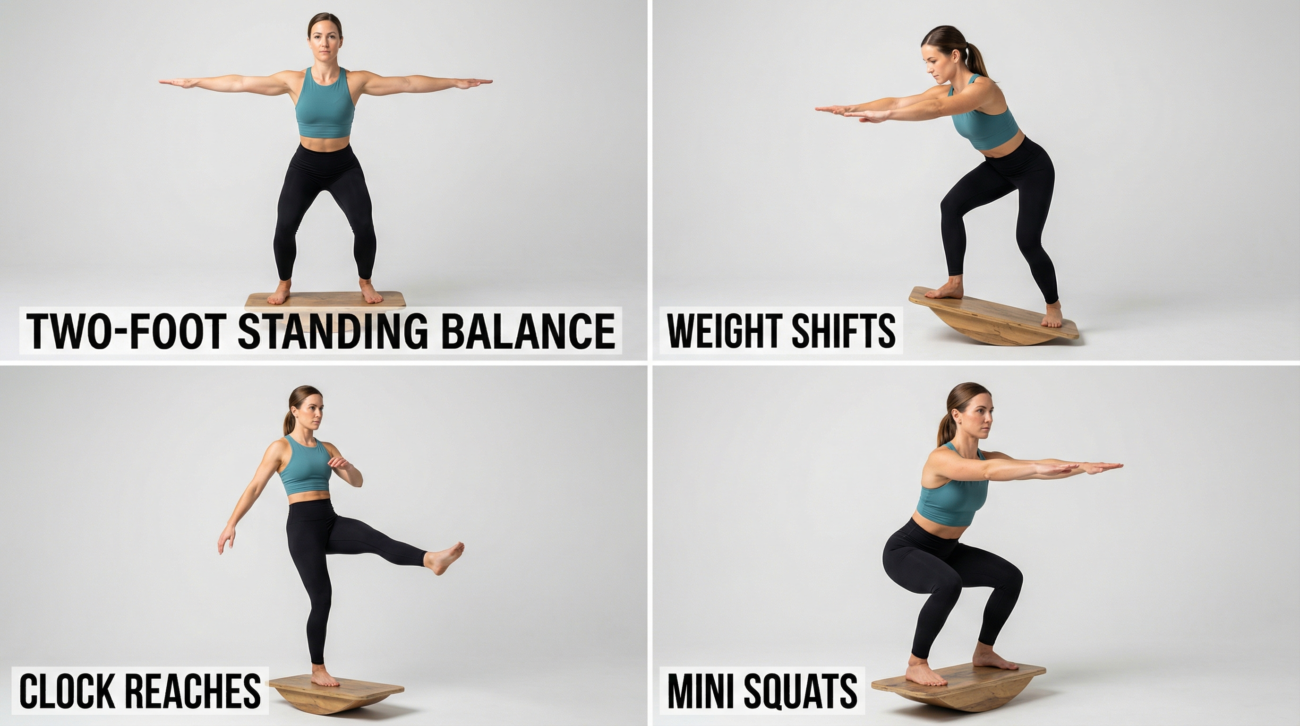
3. Clock Reaches
Muscles targeted: Core, legs, hip stabilisers
Stand on the board and imagine a clock face surrounding you. Reach one leg out to touch imaginary numbers (12 o’clock, 3 o’clock, 6 o’clock, 9 o’clock) whilst maintaining balance on your standing leg.
Complete 8 to 10 reaches per leg for 2 sets. This movement challenges single-leg stability whilst improving hip mobility and coordination.
4. Mini Squats
Muscles targeted: Quadriceps, glutes, core, ankles
Stand on the board with feet hip-width apart. Lower into a shallow squat, keeping your chest lifted and knees tracking over your toes. Return to standing whilst maintaining board stability throughout.
Perform 10 to 12 squats for 3 sets. This exercise combines lower body strengthening with balance challenge.
Intermediate Balance Board Exercises
Progress to these movements once you can maintain steady two-foot balance for 60 seconds comfortably.
5. Single-Leg Balance
Muscles targeted: Core, standing leg, ankle stabilisers
Stand on one leg whilst keeping the board level. Extend your free leg slightly forward or to the side for counterbalance. Maintain slight knee bend in your standing leg—locking your knee reduces stability and increases injury risk.
Hold for 20 to 40 seconds per leg for 3 sets each side. This significantly increases difficulty and ankle strengthening.
6. Balance Board Squats
Muscles targeted: Quadriceps, glutes, hamstrings, core
Perform full-depth squats on the board, lowering until your thighs are parallel to the floor whilst maintaining board control. Keep your weight centred and chest lifted throughout the movement.
Complete 8 to 12 squats for 3 sets. This balance board core exercise delivers excellent lower body and core strengthening simultaneously.
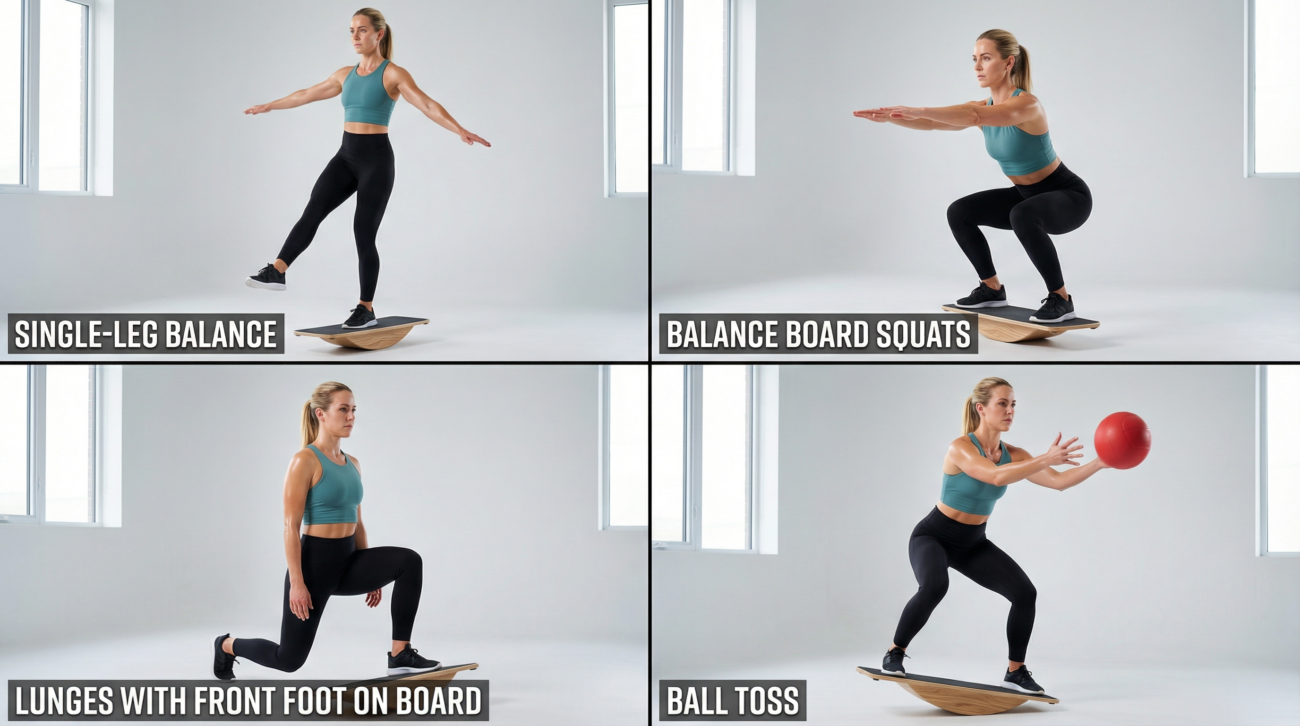
7. Lunges with Front Foot on Board
Muscles targeted: Quadriceps, glutes, hamstrings, stabilisers
Place one foot on the balance board and step the other foot back into a lunge position. Lower until your front thigh is parallel to the floor, then return to the starting position with control.
Perform 8 to 10 lunges per leg for 2 to 3 sets. The unstable surface dramatically increases the challenge of standard lunges.
8. Ball Toss
Muscles targeted: Core, full-body coordination
Stand on the board and toss a small ball against a wall or to a partner. Catch and repeat whilst maintaining stability. This adds dynamic challenge and improves reaction time under unstable conditions.
Complete 20 to 30 tosses for 2 to 3 sets. This functional exercise mimics real-world balance demands during unpredictable movement.
Advanced Balance Board Exercises
These challenging movements require solid intermediate proficiency. Master previous levels before attempting.
9. Single-Leg Squats
Muscles targeted: Entire standing leg, core, hip stabilisers
Stand on one leg on the board and lower into a single-leg squat. Extend your free leg forward for counterbalance. This extremely challenging exercise builds significant unilateral strength and stability.
Perform 5 to 8 squats per leg for 2 to 3 sets. Allow adequate rest between sets to maintain form quality.
10. Push-Ups with Hands on Board
Muscles targeted: Chest, shoulders, triceps, core
Place both hands on the balance board in push-up position. Perform push-ups whilst maintaining board stability throughout. The unstable surface dramatically increases core engagement compared to standard push-ups.
Complete 8 to 12 push-ups for 2 to 3 sets. This upper body exercise challenges strength and core stability simultaneously.
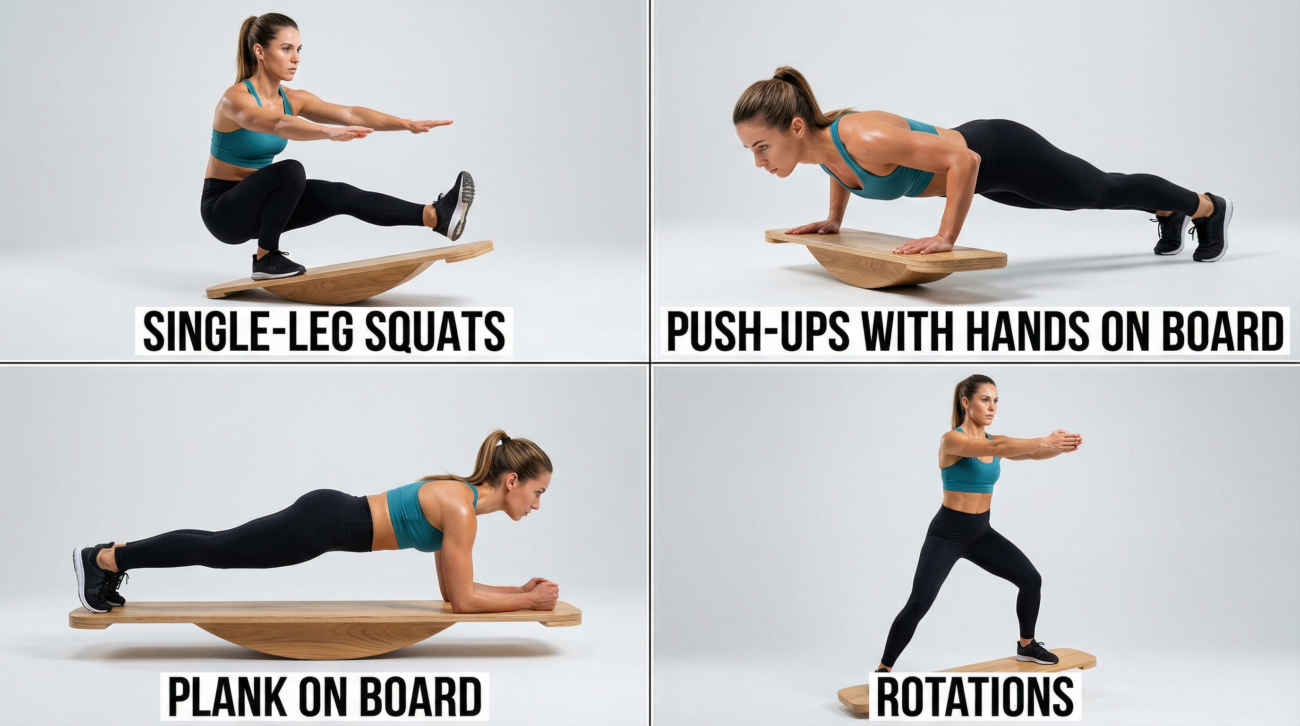
11. Plank on Board
Muscles targeted: Entire core, shoulders, stabilisers
Place your forearms on the balance board and hold a plank position whilst keeping the board level. The instability forces deep core activation throughout the hold.
Maintain for 20 to 40 seconds for 3 sets. This static hold builds remarkable core strength and postural control.
12. Rotations
Muscles targeted: Obliques, core, legs
Stand on the board and rotate your torso side to side whilst maintaining lower body stability. Hold your arms extended in front of you or hold a light weight for added challenge.
Perform 15 to 20 rotations per side for 2 to 3 sets. This exercise specifically targets rotational core strength and balance.
Sample Balance Board Workout Routines
Beginner Routine (10 minutes)
This balance board workout for beginners builds fundamental stability safely.
- Two-foot standing balance (1 minute)
- Weight shifts (2 minutes)
- Clock reaches (2 minutes each leg)
- Mini squats (2 minutes)
- Two-foot standing balance (1 minute)
Practice 3 to 4 times weekly, allowing rest days between sessions.
Intermediate Routine (15 minutes)
- Two-foot standing balance warm-up (1 minute)
- Single-leg balance (1 minute each leg)
- Balance board squats (3 sets)
- Lunges with front foot on board (2 sets per leg)
- Ball toss (3 minutes)
- Rotations (2 minutes)
Practice 4 to 5 times weekly.
Advanced Routine (20 minutes)
- Single-leg balance warm-up (1 minute each leg)
- Single-leg squats (3 sets per leg)
- Push-ups on board (3 sets)
- Plank on board (3 sets)
- Ball toss (3 minutes)
- Balance board squats (3 sets)
- Rotations (2 minutes)
Practice 5 to 6 times weekly.
Training Duration and Frequency
For general fitness and stability improvement, practice balance board exercises for 10 to 20 minutes, 3 to 5 times weekly. Beginners should start with 5 to 10 minute sessions, 3 times weekly, gradually increasing duration and frequency as stability improves.
Individual exercises typically last 20 to 60 seconds for static holds or 8 to 12 repetitions for dynamic movements. Complete workout sessions range from 10 to 20 minutes depending on your fitness level and goals.
Consistency produces results far more effectively than occasional intensive sessions. Most people notice improved balance within 2 to 3 weeks and significant stability gains within 6 to 8 weeks of regular practice.
Safety Considerations
Always practice near a stable surface like a wall or counter when starting. Use it for light support whilst developing confidence, gradually reducing reliance as stability improves.
Train barefoot or wear appropriate footwear—socks can be slippery and increase fall risk. Clear the surrounding area of obstacles and consider placing a yoga mat around the board for protection during early practice.
Stop immediately if you experience pain, dizziness, or unusual discomfort. Balance training should challenge you progressively without causing strain or injury.
Consult a healthcare provider before starting if you have existing balance problems, recent injuries, or any medical conditions affecting stability. Seniors should begin with basic exercises, use support consistently, and progress gradually under appropriate guidance.