

Blog
12 Best Door Frame Pull Up Bar Exercises (Beginner to Advanced UK Guide)

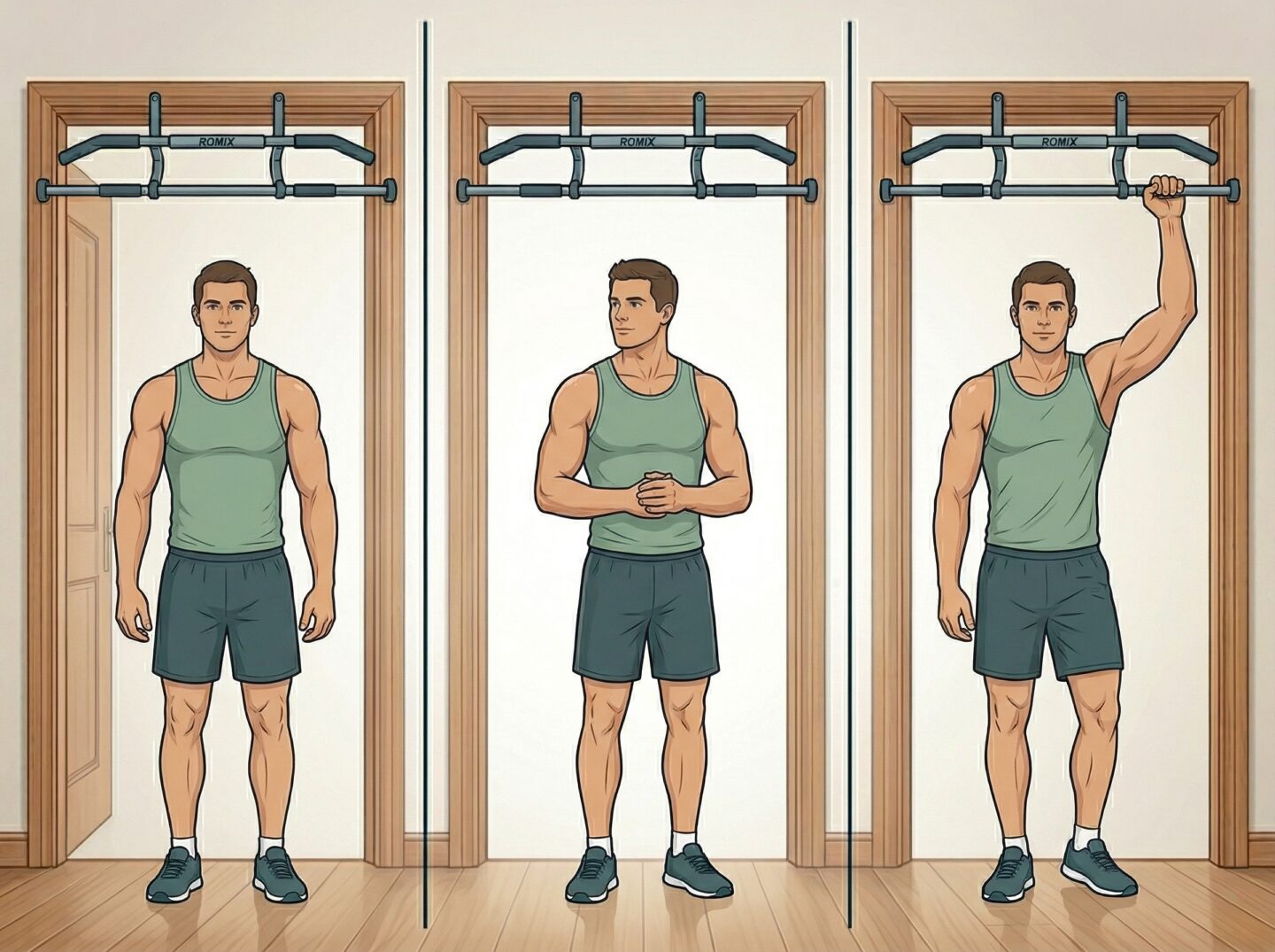
A door frame pull up bar is one of the most space-efficient pieces of home gym equipment you can own. No screws. No permanent fixtures. No wasted floor space. Just hang it in a doorway and you have access to one of the most effective upper body workouts available — at any fitness level.
This guide covers 12 of the best door frame pull up bar exercises, organised from complete beginner to advanced. Whether you cannot do a single pull up yet or you are working towards advanced calisthenics moves, there is a progression here for you.
What Muscles Does a Door Frame Pull Up Bar Work?
Before diving into the exercises, it helps to understand what you are training. Pull up bar movements primarily target:
- Latissimus dorsi (lats) — the broad back muscles that create the V-taper shape
- Biceps — especially during chin-up grip movements
- Rear deltoids — the back of your shoulders
- Rhomboids and trapezius — mid and upper back muscles that improve posture
- Core — every hanging exercise requires core stabilisation
- Grip strength — your hands and forearms work hard on every rep
This is why a pull up bar delivers so much value for such a simple piece of equipment — it trains your entire posterior chain in one movement.
Equipment You Will Need
All exercises below can be performed with the ROMIX Door Frame Pull Up Bar. It fits most standard UK doorframes without screws or drilling, making it ideal for rented properties. For some beginner exercises, a resistance band looped over the bar is helpful but not essential.
Beginner Exercises (Start Here If You Cannot Yet Do a Pull Up)
1. Dead Hang
Target muscles: Grip, shoulders, lats, core decompression Sets/reps: 3 sets of 20–30 seconds
The dead hang is where every pull up journey begins. Simply grip the bar with both hands slightly wider than shoulder width, let your body hang completely, and hold. Do not try to pull yourself up — just hang.
Why it works: Dead hangs build the grip strength and shoulder stability you need before attempting any pulling movement. They also decompress the spine, which is particularly beneficial for anyone who sits at a desk all day.
How to do it: Grip the bar overhand (palms facing away). Let your arms fully straighten. Engage your core gently. Breathe normally and hold for the target time. If 20 seconds feels easy, add five seconds each session.
2. Scapular Pull-Ups
Target muscles: Lower traps, rhomboids, lats Sets/reps: 3 sets of 8–10 reps
This is the movement that most beginners skip — and most intermediate lifters wish they had learned earlier.
How to do it: Hang from the bar with straight arms. Without bending your elbows, squeeze your shoulder blades together and downward, lifting your body by just two to three centimetres. Hold for one second at the top, then lower slowly. Your arms stay straight throughout.
Why it matters: Scapular pull-ups teach your back muscles to initiate the movement rather than your arms. This is the correct pull-up mechanics foundation.
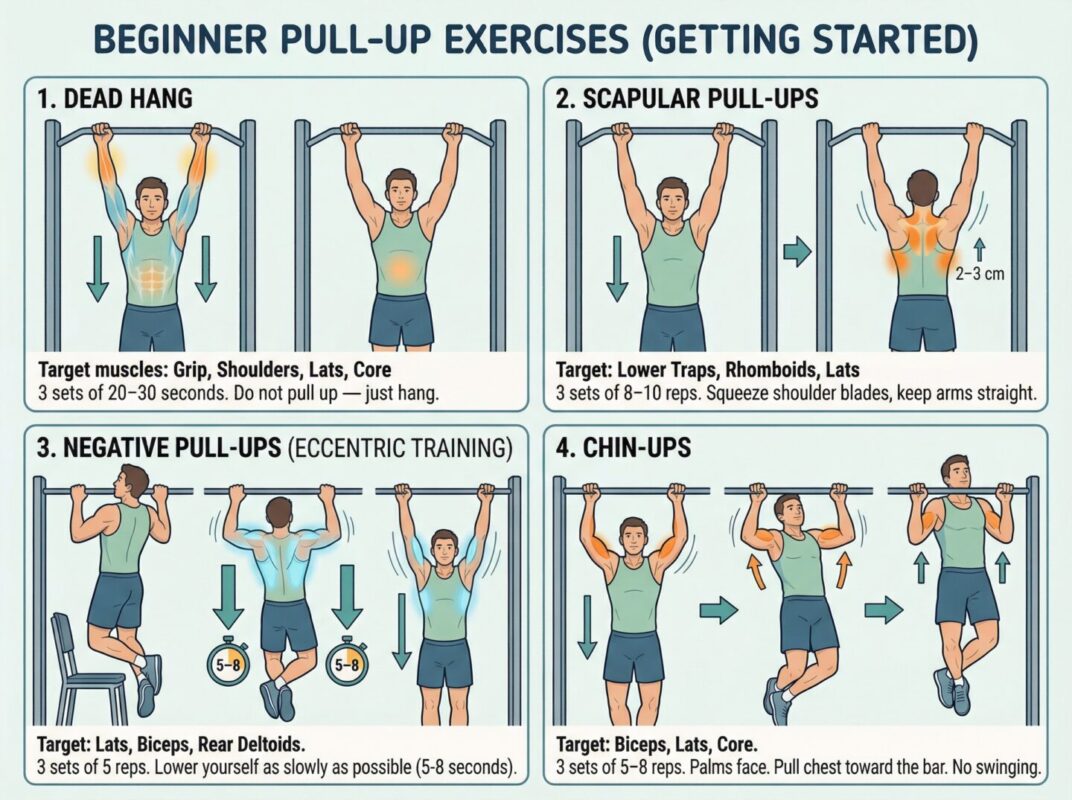
3. Negative Pull-Ups (Eccentric Training)
Target muscles: Lats, biceps, rear deltoids Sets/reps: 3 sets of 5 reps
Negatives are the fastest way to build pull-up strength when you cannot yet complete a full rep.
How to do it: Use a chair or step to get your chin above the bar. Grip the bar, remove the support, and lower yourself as slowly as possible — aim for five to eight seconds on the way down. When your arms are fully extended, step back up and repeat.
Progress tip: When you can do five negatives lasting eight seconds each, you are close to your first full pull-up.
4. Chin-Ups
Target muscles: Biceps, lats, core Sets/reps: 3 sets of 5–8 reps
Chin-ups use an underhand grip (palms facing toward you) and are typically easier than standard pull-ups because your biceps — which are stronger in most people — take on more of the load.
How to do it: Grip the bar shoulder-width apart with palms facing you. From a dead hang, pull your chest toward the bar by driving your elbows down toward your hips. Squeeze at the top, then lower with control.
Common mistake: Swinging the hips to generate momentum. Keep your body as still as possible throughout.
Intermediate Exercises (You Can Do 3–5 Pull-Ups)
5. Standard Pull-Ups
Target muscles: Lats, upper back, biceps, core Sets/reps: 3–4 sets of 5–10 reps
The foundation of upper body pulling strength. Once you have built your base with the beginner exercises above, this is your primary movement.
How to do it: Overhand grip, slightly wider than shoulder width. From a dead hang, drive your elbows down and back, pulling your chest toward the bar. Your chin should clear the bar at the top. Lower slowly and with control — the descent builds as much strength as the ascent.
Key cue: Think about pulling your elbows to your hips, not just pulling your body up. This small mental shift recruits your lats properly.
6. Wide-Grip Pull-Ups
Target muscles: Outer lats, rear deltoids, teres major Sets/reps: 3 sets of 6–8 reps
Moving your hands wider shifts more load onto the outer edges of your lats, creating the broad back appearance associated with upper body strength.
How to do it: Grip the bar as wide as comfortable — typically around one and a half times shoulder width. Perform the same pulling motion as a standard pull-up, but notice you will not be able to get your chin as high. That is normal. Focus on the lat contraction.
Note for ROMIX bar users: The ROMIX door frame pull up bar accommodates multiple grip widths — check your doorframe width to find your maximum comfortable grip position.
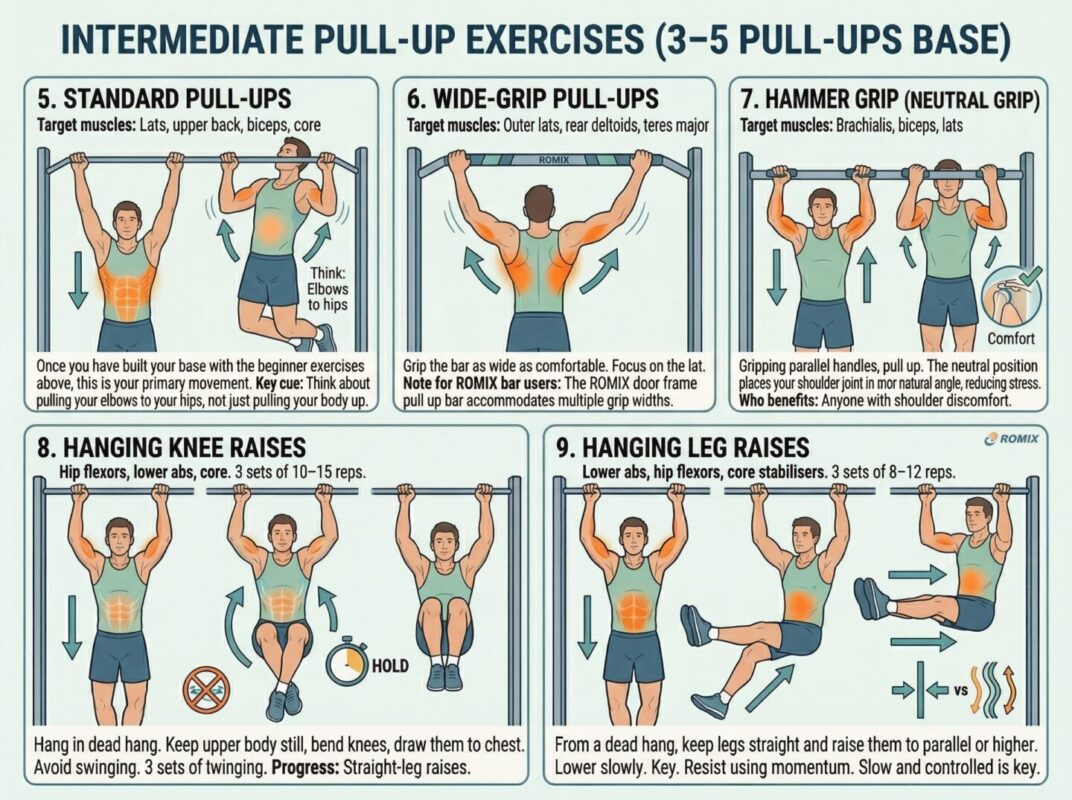
7. Hammer Grip (Neutral Grip) Pull-Ups
Target muscles: Brachialis, biceps, lats Sets/reps: 3 sets of 8–10 reps
If your door frame pull up bar has parallel handles (many do, including the ROMIX bar), neutral grip pull-ups are excellent for shoulder health and bicep development.
How to do it: Grip the parallel handles with palms facing each other. Pull up in the same motion as a standard pull-up. The neutral position places your shoulder joint in a more natural angle, reducing stress on the rotator cuff.
Who benefits most: Anyone with shoulder discomfort during standard or wide-grip pull-ups.
8. Hanging Knee Raises
Target muscles: Hip flexors, lower abs, core Sets/reps: 3 sets of 10–15 reps
Your pull up bar is not just for back exercises. Hanging knee raises transform it into a highly effective core training tool.
How to do it: Hang from the bar in a dead hang position. Keeping your upper body still, bend both knees and draw them toward your chest. Hold for one second at the top, then lower slowly. Avoid swinging — all movement should come from your hips flexing, not momentum.
Progress: Once you can do 15 controlled reps, move to straight-leg raises for greater difficulty.
9. Hanging Leg Raises
Target muscles: Lower abs, hip flexors, core stabilisers Sets/reps: 3 sets of 8–12 reps
The harder progression from knee raises. Keeping your legs straight dramatically increases the load on your core.
How to do it: From a dead hang, keep your legs straight and raise them until they are parallel to the floor (or higher if you have the strength). Lower slowly. The temptation is to use momentum — resist it. Slow and controlled gives you far better results.
Advanced Exercises (You Can Do 10+ Pull-Ups Consistently)
10. L-Sit Pull-Ups
Target muscles: Lats, abs, hip flexors, full core Sets/reps: 3 sets of 5–8 reps
Combining a hanging L-sit position with a pull-up creates one of the most demanding bodyweight upper body exercises available.
How to do it: From a dead hang, raise your legs until they are parallel to the floor and hold this position (the L-sit). Maintaining the L-sit throughout, perform pull-ups. Your core must work continuously to hold the leg position while your back and arms complete the pull.
Prerequisite: You should be able to do 10 clean pull-ups and 12 controlled hanging leg raises before attempting this.
11. Close-Grip Pull-Ups
Target muscles: Inner lats, biceps, lower traps Sets/reps: 3 sets of 8–12 reps
Bringing your hands close together (four to six inches apart) shifts the emphasis to the inner portion of your lats and increases bicep involvement significantly.
How to do it: Grip the bar with hands close together, overhand. Pull up as normal but focus on squeezing your elbows together as you rise. The range of motion may feel slightly restricted — that is normal with a close grip.
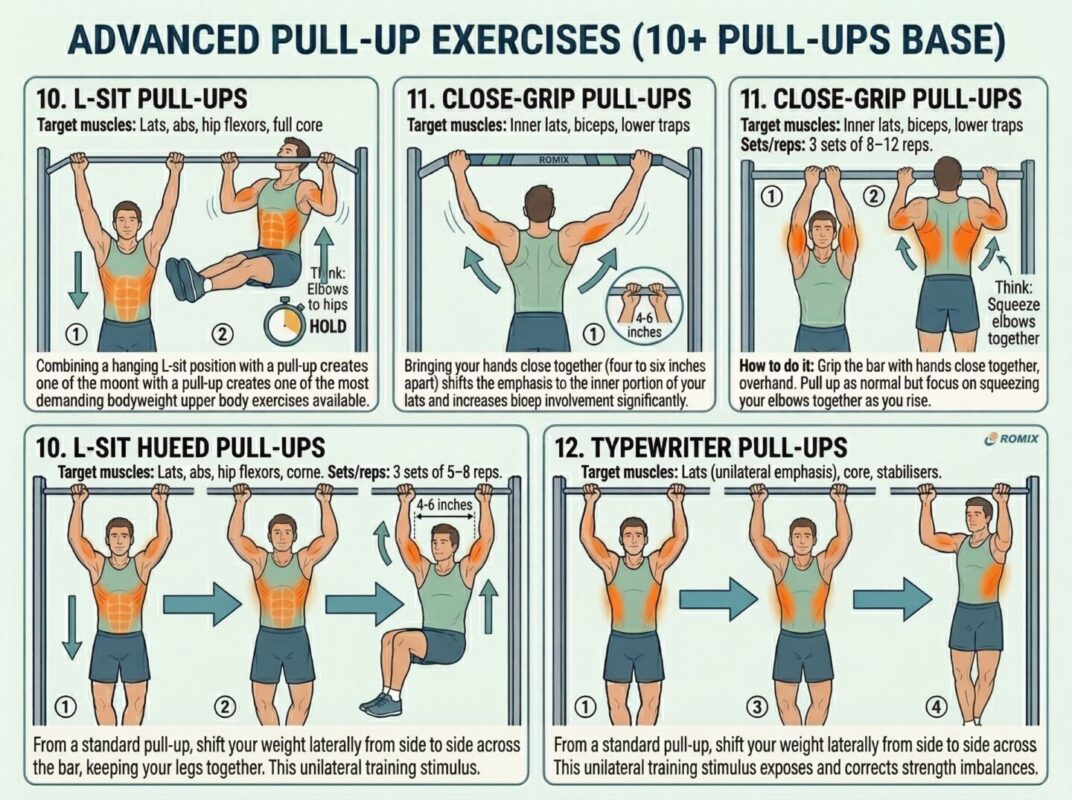
12. Typewriter Pull-Ups
Target muscles: Lats (unilateral emphasis), core, stabilisers Sets/reps: 3 sets of 4–6 reps per side
One of the most impressive bodyweight exercises you can perform on a simple door frame bar.
How to do it: Pull yourself up until your chin is above the bar. Rather than lowering straight down, shift your weight laterally to one side — moving your body along the bar like a typewriter carriage. Hold briefly with your chin near your right hand, shift back to centre, then across to the left side. Lower from centre. That is one rep.
Why it works: Typewriters create a unilateral training stimulus that exposes and corrects strength imbalances between your left and right sides.
Sample Weekly Workout Plan Using Your Door Frame Pull Up Bar
3 days per week — rest at least one day between sessions
Beginner (cannot yet do a pull-up):
- Dead hang: 3 × 30 seconds
- Scapular pull-ups: 3 × 8
- Negative pull-ups: 3 × 5 (8 seconds down)
- Chin-ups (assisted with band if needed): 3 × 5
Intermediate (3–8 pull-ups):
- Standard pull-ups: 4 × max reps
- Wide-grip pull-ups: 3 × 6
- Hanging knee raises: 3 × 12
- Hammer grip pull-ups: 3 × 8
Advanced (10+ pull-ups):
- Wide-grip pull-ups: 4 × 10
- L-sit pull-ups: 3 × 6
- Typewriter pull-ups: 3 × 4 per side
- Hanging leg raises: 3 × 12
- Close-grip pull-ups: 3 × 10
Frequently Asked Questions
Three to four times per week is optimal for most people. Pull-ups are a demanding compound movement — your back and biceps need 48 hours to recover between sessions. Beginners should start with three sessions per week.
Absolutely. Combined with push-ups and lower body bodyweight exercises, pull up bar training develops a strong, functional upper body. Many calisthenics athletes have built impressive physiques using nothing more than bars and their own bodyweight.
Yes — the ROMIX Door Frame Pull Up Bar requires no drilling, no screws, and leaves no marks on your door frame. It is held in place by the compression of your body weight during use.
Start with dead hangs and scapular pull-ups for two to three weeks. Then add negatives. Most people can do their first pull-up within four to six weeks of consistent training using this progression.
Get Your ROMIX Door Frame Pull Up Bar — Free UK Delivery
Every exercise in this guide can be performed with the ROMIX Door Frame Pull Up Bar. It fits most standard UK doorframes, requires no tools or permanent installation, and is built to support all the movements above safely.