

Blog
Best Workout Equipment for Beginners UK: What You Actually Need in 2026

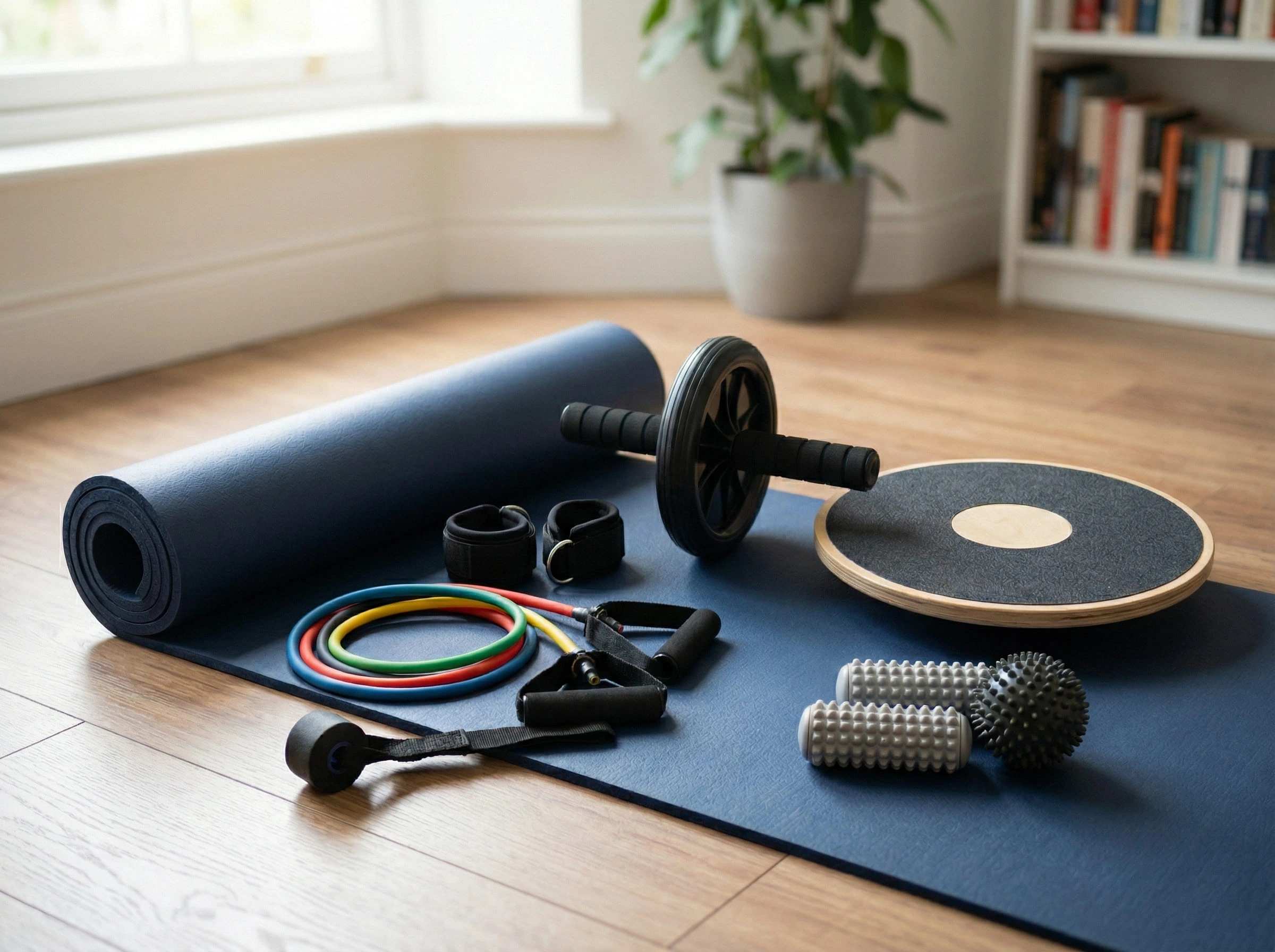
Starting a home workout routine sounds straightforward until you look at the options. Resistance bands, ab rollers, balance boards, foot massage rollers — the list grows fast, the prices vary wildly, and most beginners end up either buying too much or buying the wrong things entirely.
Here is the honest truth: you need five pieces of equipment to build a complete beginner home gym in the UK. Not fifteen. Not a room full of machines. Five compact, affordable tools that cover strength, stability, core, and recovery — all of which store under your bed or in a cupboard when you are done.
This guide covers exactly what those five pieces are, why each one matters for beginners specifically, and what to look for when choosing yours. Everything here ships free across the UK and fits into a British flat, rental property, or small home without drilling a single wall.
Why Beginners Quit — And How the Right Gear Fixes It
Around 80% of people who start a new fitness routine quit within three months. The reasons are nearly always the same: equipment that is too complicated, too heavy, or too expensive to justify using daily.
The fix is simpler than most fitness brands want you to believe. Beginner workout gear should be:
- Lightweight enough to use on day one without prior strength
- Compact enough to live in a flat without a dedicated gym room
- Versatile enough to cover multiple muscle groups
- Affordable enough that you do not feel guilty if you miss a week
Every piece of equipment below meets all four of those criteria. None of them require a gym membership, a personal trainer, or any prior experience.
The 5 Best Pieces of Workout Equipment for Beginners in the UK
1. Resistance Bands — The Most Versatile Piece You Will Own
If you could only start with one piece of equipment, resistance bands would be it. They cover more exercises per pound spent than anything else on this list — chest, back, shoulders, arms, legs, glutes, and core are all reachable with a single set.
Why they work for beginners: Unlike weights, resistance bands are forgiving. The tension increases gradually as you stretch them, which means your muscles are never hit with a sudden heavy load that can cause injury. They are also joint-friendly — a critical advantage when your body is still adapting to regular exercise.
A quality set includes five bands at different resistance levels — typically colour-coded from light to heavy — plus handles, ankle straps, and a door anchor. That single kit covers every exercise a beginner needs for the first six to twelve months of training.
What to look for:
- Natural latex construction
- Metal carabiner clips — not plastic, which snaps under tension
- Non-slip foam handles that absorb sweat during sessions
- Adjustable ankle straps for lower body exercises
- A carry bag so the set stays organised and tidy
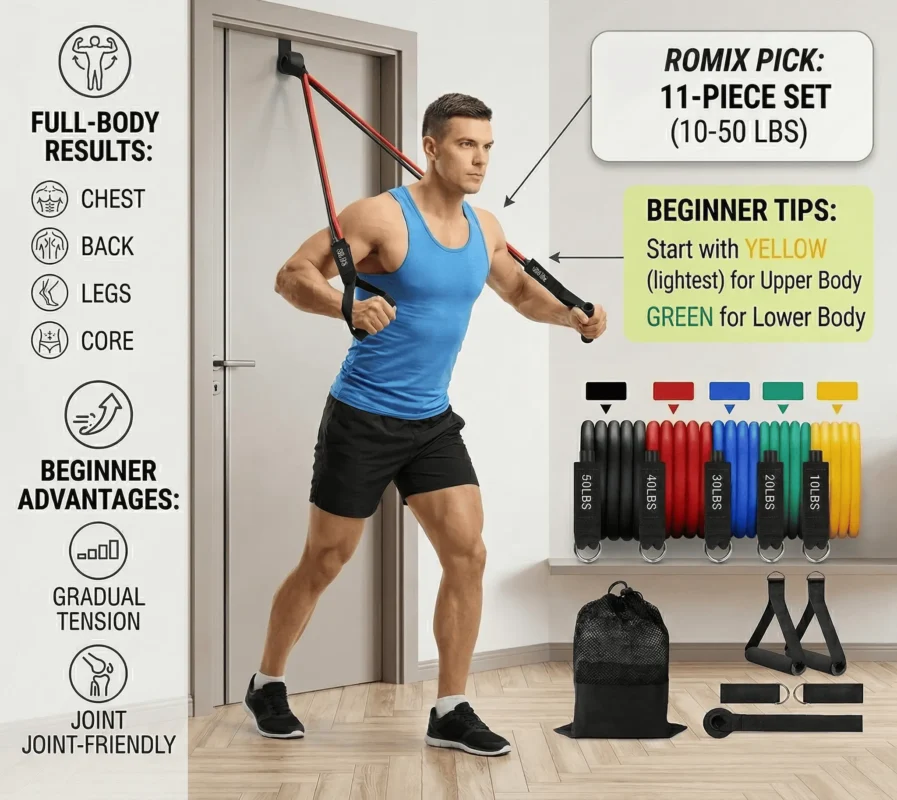
ROMIX pick: Resistance Tubes with Handles — 11-Piece Set — five resistance levels from 10lbs to 50lbs, door anchor, ankle straps, and carry bag included. Free UK delivery.
Beginner tip: Start with the yellow (lightest) band for upper body and the green for lower body. Combine bands only once you can complete 15 reps with clean form on the heaviest single band. Progressing through the colour levels over several months provides built-in progressive overload without buying new equipment.
2. Yoga Mat — Your Foundation for Every Floor Exercise
A yoga mat is not just for yoga. It is the foundation of your entire floor workout — planks, core work, stretching, meditation, Pilates, bodyweight circuits. Without one, you are working on a hard surface that punishes your knees, elbows, and spine during every session.
Why thickness matters for beginners: Most beginners underestimate how much time they will spend on their knees. Standard 4mm mats are designed for studio floors with sprung surfaces. UK home floors — laminate, tiles, concrete — are unforgiving. A 10mm mat is the minimum recommendation for beginners; 15mm if you have sensitive knees or weigh over 85kg.
What to look for:
- Non-slip texture on both sides — grips the floor and your hands simultaneously
- Eco-friendly TPE or NBR foam, not standard PVC
- Carry bag or strap included for easy roll-up storage
- Easy-wipe surface for maintenance after sweaty sessions
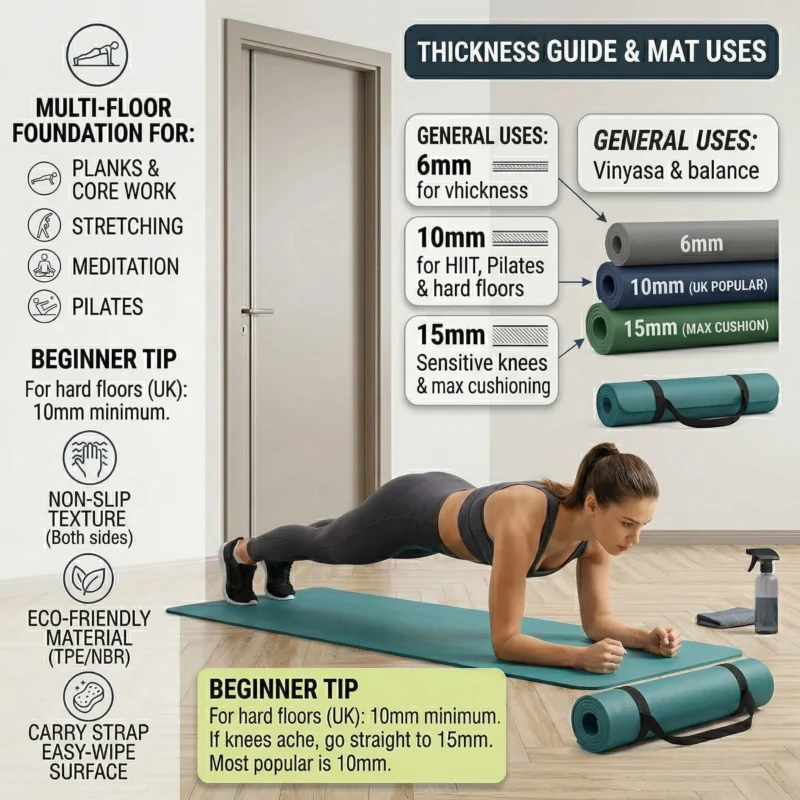
ROMIX picks:
- 6mm Yoga Mat — for Vinyasa, balance poses, and carpet surfaces
- 10mm Yoga Mat — for HIIT, Pilates, and hard floors (most popular choice for UK beginners)
- 15mm Yoga Mat — for sensitive knees, arthritis, and maximum cushioning on cold British floors
Beginner tip: If you exercise on laminate or tiles, go 10mm as a minimum. If your knees already ache before you have even started, go straight to 15mm — you will use it every session rather than avoiding floor exercises because of discomfort.
3. Ab Roller — The Most Efficient Core Tool at Any Price Point
The ab roller looks almost too simple to work. It does not. Every controlled rollout simultaneously engages your rectus abdominis, transverse abdominis, obliques, lats, shoulders, and lower back — more muscle activation than hundreds of crunches in a fraction of the time.
Why it is ideal for beginners: Despite its reputation as an advanced tool, the ab roller is completely scalable. Complete beginners start with knee rollouts and wall-assisted partials. Within four to six weeks, most people progress to full rollouts with confidence. The learning curve is short and the results are measurable — most users notice genuine improvements in core stability within three weeks of consistent use.
What to look for:
- Single-wheel design — provides more core challenge than wide double-wheels
- Stainless steel axle, not plastic, which bends under load
- Non-slip foam handles that remain secure when sweaty
- High-density knee pad included — you will appreciate this immediately
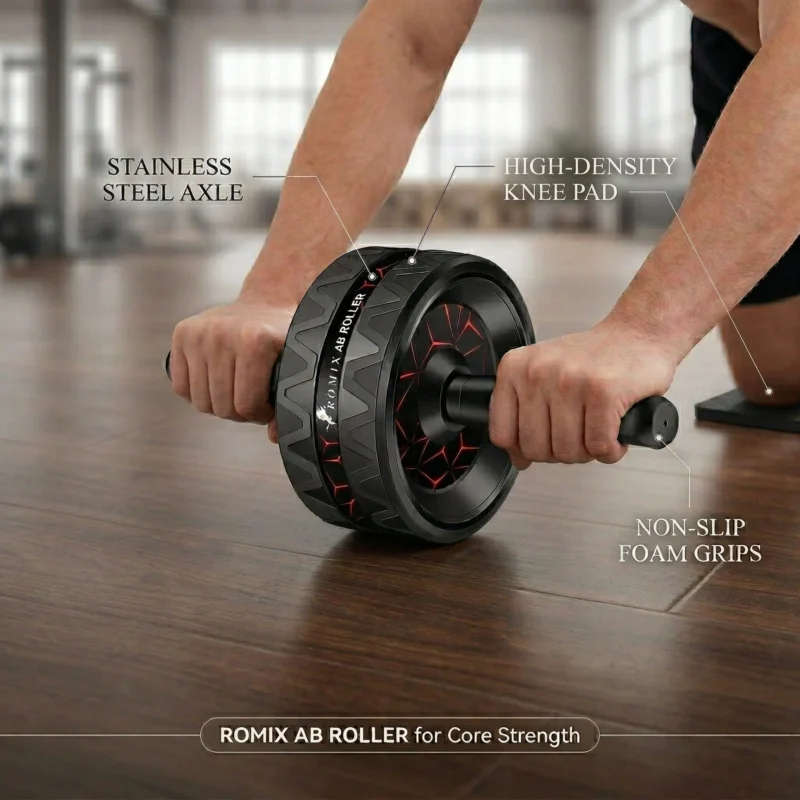
ROMIX pick: Ab Roller for Core Strength — with Knee Pad — stainless steel shaft, non-slip foam grips, high-density knee pad included. Supports users up to 120kg. Free UK delivery.
Beginner tip: Start facing a wall. Place the roller against the skirting board, kneel, and roll forward until you feel your core engage — the wall stops you going too far. Aim for 3 sets of 8 reps, three times a week. Progress to full rollouts once you can complete 15 wall-assisted reps with no back sag whatsoever.
4. Balance Board — The Equipment Most Beginners Skip (And Genuinely Should Not)
Balance boards are consistently underrated in beginner guides. Most people reach for weights or bands first — but if your stability and coordination are weak, every other exercise suffers for it. Squats become unsafe. Core work lacks control. The balance board fixes the foundation that everything else builds on.
Why it matters early in your training: Standing on an unstable surface for 15 minutes a day forces your core, ankles, hips, and stabiliser muscles to activate constantly. This neurological adaptation — called proprioception — transfers directly to every other exercise you do. Beginners who train balance first progress measurably faster across every discipline they take on.
Beyond training, balance boards are used by physiotherapists across the UK for ankle and knee rehabilitation. They are low-impact enough for active rest days and genuinely enjoyable enough that you will use them consistently — which is more than can be said for most gym equipment.
What to look for:
- Solid wood construction — significantly more durable than plastic alternatives
- Anti-slip surface on both sides for safety during use
- 360° rotation capability for full balance and stability training
- Weight capacity above 100kg for safe, confident use
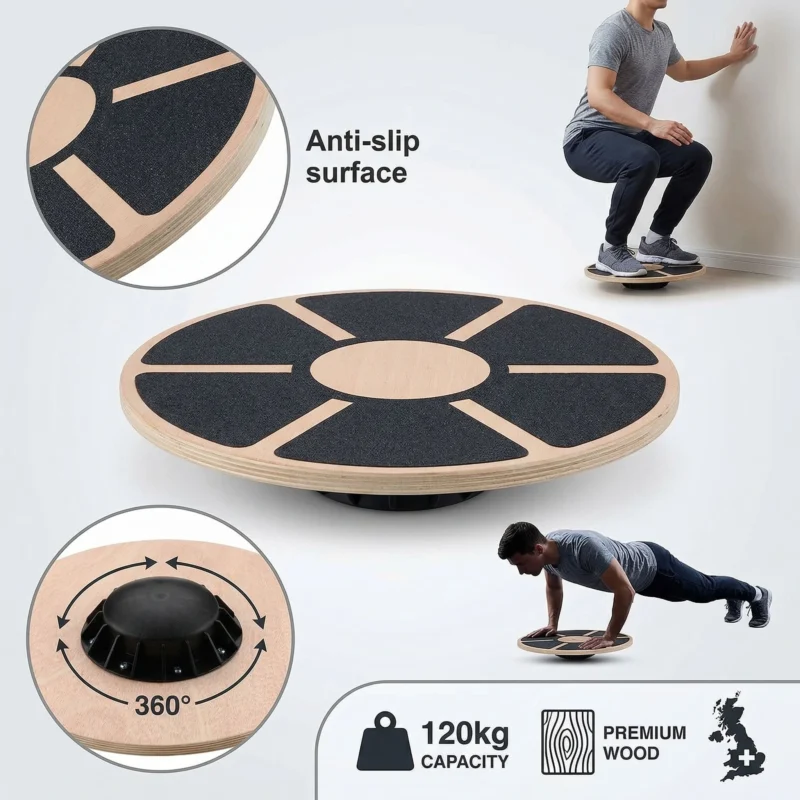
ROMIX pick: 40cm Wooden Balance Board — premium wood, anti-slip pad, 360° tilt and rotation, 120kg capacity. Free UK delivery.
Beginner tip: Position yourself near a wall for your first week. Stand on the board, rest one hand lightly on the wall, and simply try to keep the edges off the floor. Aim for 60-second holds before progressing to squats and then push-up variations on the board. Twenty minutes a day for the first month produces noticeable stability improvements that you will feel in every other exercise you do.
5. Foot Massage Roller — The Recovery Tool That Keeps You Training Consistently
Beginners make one consistent mistake: they skip recovery entirely. Muscle soreness and foot fatigue from your first few sessions are completely normal — but if you do not manage them, that discomfort becomes the reason you skip workouts the following day. That is where most people's fitness routines end.
A foot massage roller releases tension through targeted deep-tissue pressure — the same technique used by physiotherapists in UK clinics, but in the comfort of your own home. Used for five to ten minutes after each session, it significantly reduces post-workout soreness in your feet, calves, and legs, improves blood circulation, and speeds up the recovery that allows you to train again sooner.
Why beginners specifically need one: When your body is not yet conditioned to regular exercise, foot and lower leg fatigue is more intense and lasts longer than it will once you are fitter. Many beginners abandon their routines not because they lack motivation, but because they are simply too uncomfortable to continue. A foot massage roller addresses this directly and inexpensively.
The ROMIX foot roller also works across multiple body parts — calves, hamstrings, forearms, shoulders, and wrists — making it genuinely versatile despite its compact size. The included spiky ball targets specific trigger points with even more precision than the roller alone.
What to look for:
- Textured or spiked surface — smooth rollers do not penetrate deep enough to be effective
- Medical-grade PVC or TPR material — non-toxic and phthalate-free
- Spiky ball included for trigger point work on specific areas
- Compact enough to use seated on a sofa or office chair during the day
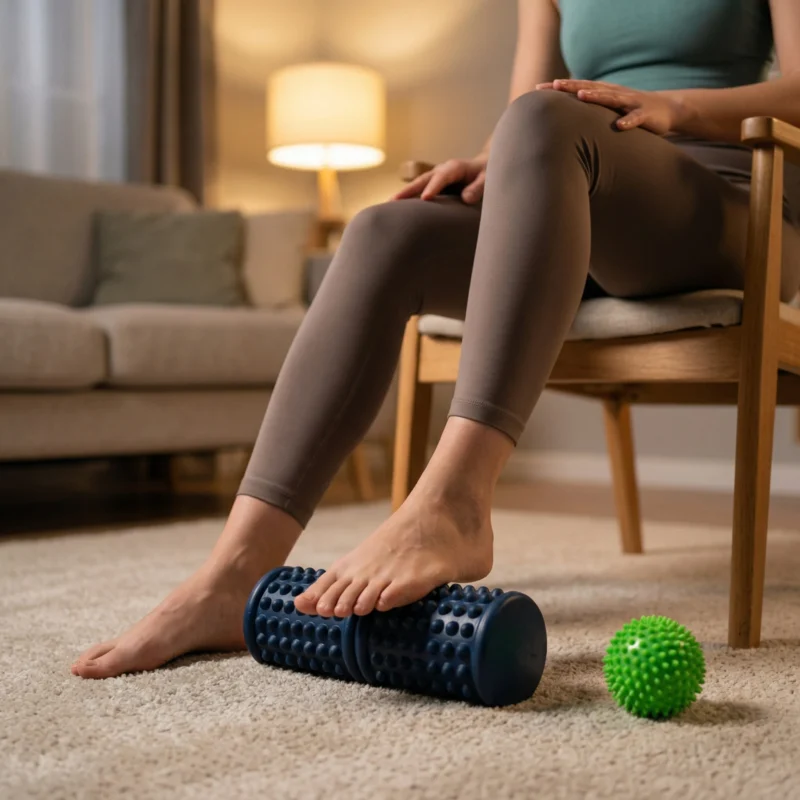
ROMIX pick: Foot Roller for Plantar Fasciitis Relief Kit — 16cm textured roller plus 6cm spiky trigger point ball included. Medical-grade PVC, non-toxic, suitable for feet, calves, forearms, and shoulders. Free UK delivery.
Beginner tip: Use it every evening after training — even on rest days. Sit in a chair, remove your shoes, place the roller under the arch of your foot, and roll slowly back and forth for three to five minutes per foot. Increase pressure gradually by shifting more body weight downward. For tighter spots on your calves or forearms, use the spiky ball directly on the tension point and hold for 20 to 30 seconds. Most customers notice significant improvement within the first week of daily use.
What This Kit Costs — And Why It Beats a Gym Membership
The average UK gym membership costs between £30 and £50 per month — between £360 and £600 a year. Research consistently shows that the majority of memberships go unused after the first three months, meaning most people pay hundreds of pounds for a facility they stop visiting.
These five pieces of ROMIX equipment — resistance bands, yoga mat, ab roller, balance board, and foot massage roller — cover the full beginner training spectrum: strength, flexibility, core, stability, and recovery. Together they represent a fraction of a single year's gym membership, they never close, require no commute, and work perfectly in any room of your home.
How to Use These 5 Pieces Together: A Simple Beginner Week
You do not need a complicated programme. This covers everything a beginner needs:
Monday — Resistance bands (upper body: chest, shoulders, back) + foot massage roller (5–10 minutes)
Tuesday — Balance board (20 minutes) + yoga mat stretching (10 minutes)
Wednesday — Rest, or foot massage roller only whilst watching television
Thursday — Ab roller (3 sets × 8–12 reps) + resistance bands (lower body: legs, glutes) + foot massage roller
Friday — Yoga mat full-body session (planks, press-ups, core work, stretching)
Weekend — Active rest. Balance board for 10–15 minutes counts perfectly.
Three to four sessions per week at 30 to 45 minutes each is all you need to see real progress within the first eight weeks. Do not be tempted to train every single day — rest days are when your muscles actually repair and grow stronger.
Common Beginner Mistakes to Avoid
Going too heavy too soon. Start with the lightest resistance band. Your instinct will tell you it feels too easy. Your body will tell you otherwise by day three when you feel muscles working that you had no idea existed.
Skipping recovery. Post-workout foot and leg fatigue feels manageable right up until session four, when soreness stops you training altogether. Use your foot massage roller after every session from day one and it never becomes a problem.
Training every single day. Three to four days of quality, focused training beats seven days of exhausted, half-hearted sessions every time. Rest is not weakness — it is part of the process.
Buying too much equipment. Five pieces is genuinely enough for twelve months of progressive training. Do not add more until your current kit can no longer challenge you adequately.
Ignoring balance and stability. Most beginners skip the balance board in favour of equipment that feels more intense. This is a mistake. Stability work builds the foundation that makes every other exercise safer and more effective throughout your entire fitness journey.
Frequently Asked Questions
The five essentials are resistance bands, a yoga mat, an ab roller, a balance board, and a foot massage roller. These cover strength, core, stability, flexibility, and recovery — everything a beginner needs for a full year of progressive training at home.
A complete beginner setup from ROMIX costs a fraction of a single month's gym membership. All pieces include free UK delivery and are designed specifically for small UK homes, rented flats, and properties where drilling is not permitted.
A yoga mat is an excellent foundation but covers primarily floor exercises and stretching. Adding resistance bands immediately expands your workout options across every major muscle group without significantly increasing cost or storage space.
Resistance bands — without question. They are the most versatile, most beginner-friendly, and most space-efficient piece of fitness equipment available. They cover over 100 exercises across every muscle group and cost less than a single gym session.
Foot and lower leg fatigue is one of the most common reasons beginners quit in their first month. A foot massage roller relieves post-workout soreness, improves blood circulation, and speeds up recovery — keeping you comfortable enough to train consistently. At just a few minutes per day, it is the simplest and most underrated habit in beginner fitness.
Yes. The high tension, full range of motion, and time under tension create mechanical stimulus for muscle growth in your abs and supporting muscles.
Whilst it emphasizes core muscles, it engages your lats, shoulders, chest, arms, and lower back significantly. This makes it one of the most comprehensive single exercises for upper body and core development.
Ready to Get Started?
Browse the full ROMIX home strength training equipment collection — compact, affordable gear designed specifically for British homes, with free UK delivery on every order.
Already have the basics and want to expand your setup? Read our guide to the 11 best space-saving home workout equipment picks — ideas for building out your home gym without losing more floor space than a yoga mat.